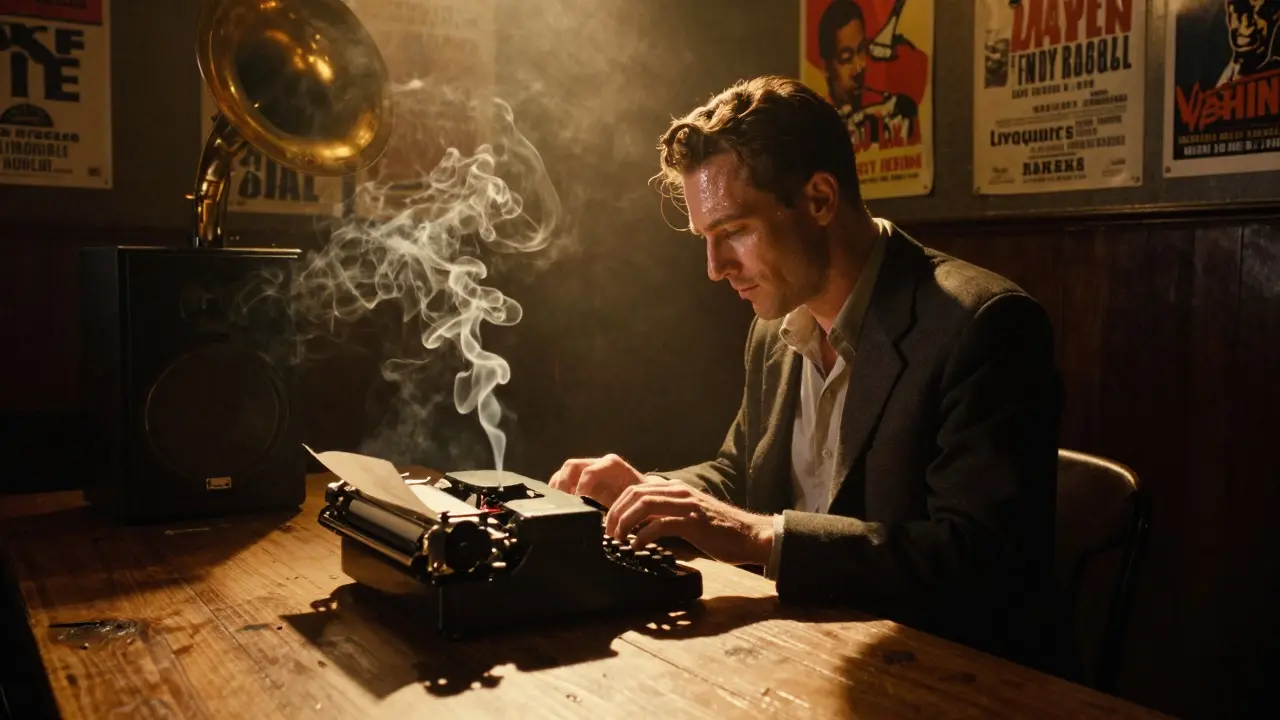
On a hot night in 1950, Jack Kerouac sat in a dimly lit San Francisco jazz club, a typewriter on his lap, sweat on his brow, and Charlie Parker’s saxophone screaming through the room. He didn’t just listen-he absorbed. Every riff, every pause, every wild swing of notes became part of his writing. That’s how jazz music didn’t just influence Beat Literature-it rewired it.
Jazz as a Rhythm for Rebellion
Before the Beats wrote about cross-country road trips, drug experiments, and spiritual hunger, they first heard the sound of jazz. It wasn’t background noise. It was the pulse beneath their words. In the 1940s and 50s, bebop was the new sound-fast, complex, unpredictable. Musicians like Charlie Parker, Dizzy Gillespie, and Thelonious Monk broke away from swing’s rigid structure. They played off-beat, skipped chords, and twisted melodies like they were improvising their lives. That’s exactly what the Beats did with language.
Allen Ginsberg once said, “I heard the music in my head before I wrote the poem.” His famous poem Howl doesn’t read like verse-it reads like a long, breathless solo. Lines spill out without punctuation, building momentum like a saxophone solo racing toward a climax. There’s no pause. No reset. Just raw energy. That’s jazz in print.
Improvisation: The Writing Style That Didn’t Plan
Most writers plan their sentences. The Beats didn’t. Kerouac’s method-“spontaneous prose”-was borrowed straight from jazz. He’d sit down with a roll of teletype paper, no edits, no revisions, and write as if he were playing a solo. No stopping. No backtracking. He called it “bop prosody.”
Think of it like this: a jazz musician doesn’t rehearse every note. They know the chord changes, the melody, the feel-and then they let their fingers do the talking. Kerouac did the same. In On the Road, the prose rushes forward like a train on loose tracks. Sentences stretch, break, double back, and surge again. There’s no grammar police. No editor breathing down his neck. Just feeling. That’s the jazz equivalent of a solo that goes off-script-and somehow, it works.
Compare that to traditional 1950s literature: clean, polished, structured. Think of John Updike or J.D. Salinger. Their sentences were tidy. The Beats? They were messy. And that mess was intentional. They didn’t want to sound smart. They wanted to sound alive.
The Connection Between Nightlife and the Written Word
The Beats didn’t write in libraries. They wrote in basements, in bars, in after-hours clubs. Places where jazz played until dawn. These weren’t just hangouts-they were creative labs. Writers and musicians shared the same spaces, the same drugs, the same hunger for something real. In New York’s Five Spot, in San Francisco’s Black Hawk, in Paris’s Left Bank, poets and horn players swapped ideas. Ginsberg recited poems to Monk. Kerouac drank bourbon with Miles Davis. They didn’t need to talk much. The music said it all.
That’s why so many Beat writings mention jazz clubs, record players, and late-night sessions. It’s not decoration. It’s the setting of their rebellion. In On the Road, Sal Paradise doesn’t just drive across America-he chases the sound of jazz. He says, “I wanted to get to the music before it stopped.” That’s the heart of it. The music was fleeting. The words had to catch it before it vanished.
Breaking Rules: Jazz and the Rejection of Conformity
Jazz was illegal in some places. It was labeled “noise.” It was Black art that white audiences loved but rarely respected. The Beats saw themselves in that. They were outsiders too. They rejected the American Dream. They mocked suburbia. They called out hypocrisy. Jazz gave them a model: if you’re not supposed to play like this, then play harder.
BeBop broke the rules of harmony. The Beats broke the rules of grammar. Jazz musicians played in 5/4 time when everyone else used 4/4. The Beats wrote in run-on sentences when everyone else used periods. Both refused to fit in. Both said: if the system wants control, we’ll give it chaos.
That’s why jazz became more than a genre to them-it became a philosophy. It was freedom. It was risk. It was the sound of someone saying, “I don’t care what you think. I’m playing this because it’s true.”
Names That Mattered: The Musicians Behind the Words
It wasn’t just the sound-it was the people. Charlie Parker, nicknamed “Bird,” was a god to the Beats. His playing was so fast, so emotional, so unpredictable that they saw him as a prophet. Kerouac wrote an entire poem called “Mexico City Blues” in homage to him. Ginsberg called Parker “the saint of the horn.”
Miles Davis wasn’t just a trumpet player. He was the quiet, cool counterpoint to Parker’s fire. His album Kind of Blue (1959) came out right as the Beats were hitting their peak. The album’s spare notes, its slow build, its space between sounds-that’s the mood of The Dharma Bums. It’s not loud. It’s not frantic. It’s meditative. Davis gave them a new rhythm: silence as power.
And then there was Billie Holiday. Her voice carried pain, longing, and dignity all at once. Ginsberg once said her singing was “the sound of a soul being stripped bare.” He quoted her in Howl: “I saw the best minds of my generation destroyed by madness.” That line? It echoes her song “Strange Fruit.”
Why Jazz Still Matters to Literature Today
People think the Beats are just a 1950s fad. But their influence is everywhere. Look at modern spoken word. Look at rap. Look at how writers like Patti Smith or Tom Waits blend music and poetry. They didn’t invent it-but they proved that words could swing.
Today’s writers still use jazz as a template. The rhythm of a tweet thread? That’s bebop. The stream-of-consciousness of a TikTok monologue? That’s Kerouac on a phone. The way poets now perform live, with backing tracks, with pauses, with improvisation? That’s the legacy of the Beats, and the jazzmen who taught them how to breathe.
Jazz didn’t just give the Beats a soundtrack. It gave them a way to write. Not just with words-but with pulse, with breath, with risk. And that’s why, 70 years later, you can still hear it in every line that dares to break the rules.
Did jazz directly inspire the writing style of the Beat writers?
Yes. Writers like Jack Kerouac and Allen Ginsberg explicitly modeled their prose on jazz improvisation. Kerouac developed "spontaneous prose," where he wrote without editing, mimicking the flow of a saxophone solo. Ginsberg’s long, breath-driven lines in "Howl" were directly shaped by the phrasing of bebop musicians like Charlie Parker. They didn’t just like jazz-they tried to make their writing sound like it.
Which jazz musicians were most important to the Beat Generation?
Charlie Parker was the most influential-his fast, emotional solos became a symbol of artistic freedom. Dizzy Gillespie and Thelonious Monk were also central figures, especially in New York’s jazz scene. Miles Davis offered a quieter, more contemplative model that influenced later Beat works like The Dharma Bums. Billie Holiday’s vocal expression of pain and resilience deeply affected Ginsberg’s poetry. These musicians weren’t just background noise-they were mentors in sound.
How did jazz challenge traditional literary forms in the 1950s?
Traditional literature of the time was structured, polished, and formal. Jazz, by contrast, embraced chaos, spontaneity, and emotional rawness. The Beats used this as a blueprint: they dropped punctuation, ignored grammar rules, and wrote in long, unbroken streams of thought. This was a direct rebellion against the clean, controlled style of mainstream fiction. Jazz gave them permission to be messy-and to call that mess truth.
Were the Beat writers only influenced by bebop, or did other jazz styles matter too?
While bebop was the dominant influence-especially for early Beats like Kerouac and Ginsberg-other styles mattered too. Cool jazz, led by Miles Davis, introduced a more restrained, meditative tone that shaped later works. Modal jazz, with its open harmonies, mirrored the spiritual searching in On the Road. Even early swing and blues played a role in their understanding of rhythm and emotional expression. Jazz wasn’t one sound-it was a spectrum, and the Beats drew from all of it.
Is there a modern literary movement still influenced by jazz today?
Absolutely. Spoken word poetry, slam poetry, and even some forms of contemporary fiction owe their energy to the Beats’ jazz-inspired style. Writers like Claudia Rankine and Ocean Vuong use rhythm, repetition, and breath-like pacing that echo Ginsberg’s long lines. Hip-hop artists like Kendrick Lamar and A Tribe Called Quest openly cite Kerouac and the Beats as influences. The idea that writing can be performed, improvised, and emotionally raw-all of that started with jazz.