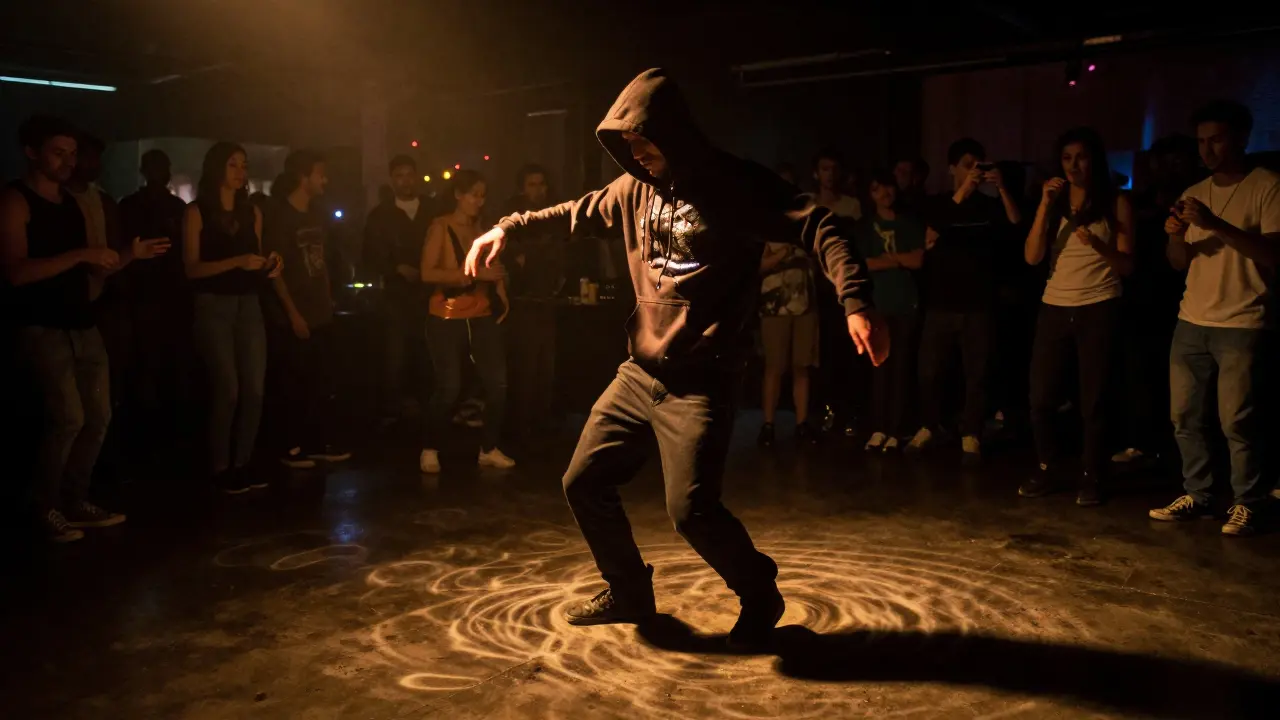
When the first heavy wobble hit the speakers at a Melbourne warehouse party back in 2010, no one expected the floor to turn into a battlefield of jerking limbs and sharp head nods. But that’s exactly what happened. Dubstep dance didn’t just appear-it erupted. It wasn’t taught in studios or choreographed by pros. It was born in the chaos of bass drops, in the sweat-drenched corners of underground clubs, and in the minds of kids who didn’t care about rules, only rhythm.
What Dubstep Dance Actually Looks Like
Dubstep dance isn’t one thing. It’s a mix of glitchy body movements, robotic isolations, and sudden freezes that look like someone hit pause on a video game. You’ll see dancers flick their wrists like they’re swatting flies, drop their shoulders with sharp precision, and bounce on the balls of their feet like they’re walking on hot pavement. The signature move? The wobble. Not the bassline-the body. Dancers mimic the low-frequency pulses with their torsos, arms, and even their heads, turning sound into motion.
Unlike hip-hop’s flow or house’s groove, dubstep dance thrives on disruption. It’s not smooth. It’s jagged. It’s unpredictable. And that’s the point. When the beat drops, your body doesn’t follow-it reacts. It’s not choreography. It’s reflex. Think of it like a human version of a subwoofer vibrating in sync with a 60Hz tone. Your joints become speakers.
Where It Came From
Dubstep dance didn’t come from a dance studio. It came from the UK underground-specifically South London and Bristol-in the early 2000s. As producers like Skream, Benga, and Coki started crafting tracks with sub-bass that rattled ribcages, people began moving in ways that matched the music’s texture. Early footage from clubs like FWD>> shows dancers with no formal training, just raw instinct. They weren’t trying to impress. They were trying to survive the sound.
By 2008, the scene had spread to the U.S., especially in cities like Los Angeles and New York. But it wasn’t until the rise of YouTube and viral videos-like the infamous 2010 clip of a guy in a hoodie doing a full-body wobble in a parking lot-that the world took notice. The video got 12 million views in three months. Suddenly, teens everywhere were trying to copy the moves. Schools banned it. Parents panicked. DJs started playing it louder.
Why It Spread Like Fire
Dubstep dance took off because it was accessible. You didn’t need years of training. You didn’t need fancy clothes or a mirror-lined studio. All you needed was a beat that made your chest feel like it was being punched from the inside. And when that beat hit, your body knew what to do-even if your brain didn’t.
It also tapped into something deeper: the need to release tension physically. Dubstep music is heavy. It’s dark. It’s intense. People were carrying stress, anxiety, anger-and the dance gave them a way to shake it out. A 2013 study from Goldsmiths, University of London, found that participants who danced to dubstep reported higher levels of emotional release compared to those dancing to pop or electronic dance music. The bass wasn’t just sound. It was therapy.
The Moves You’ll See Today
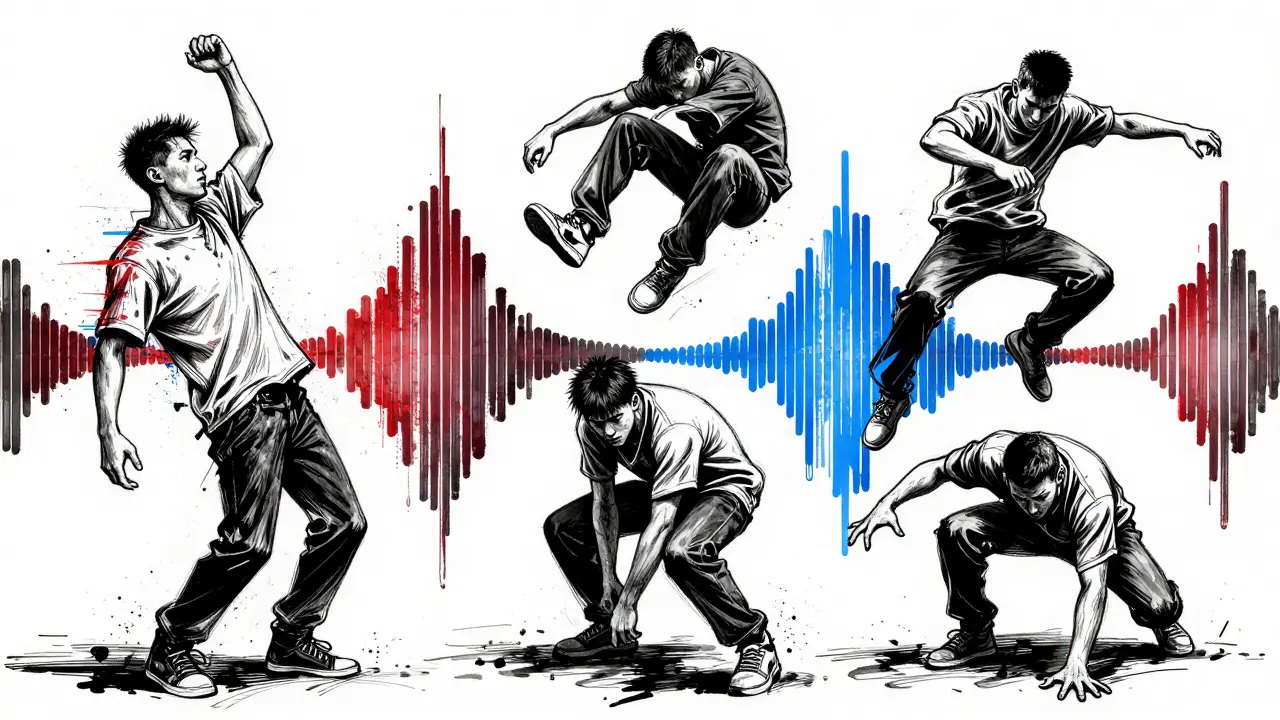
Modern dubstep dance has evolved into a few recognizable styles, each with its own flavor:
- The Wobble - The original. A side-to-side or up-and-down body ripple, usually synced to the bassline’s pulse. Done right, it looks like your spine is made of rubber.
- The Glitch - Quick, stuttering steps or arm jerks that mimic digital distortion. Think of a corrupted video file, but with your body.
- The Freeze - A sudden stop mid-motion, held for a beat or two before exploding into the next move. Often paired with a stare-down or head tilt for dramatic effect.
- The Bounce - Not a jump. More like a controlled, low-to-the-ground recoil. Feet stay planted. Knees bend. It’s the foundation for almost every other move.
- The Hand Claw - Fingers curled like claws, snapping outward with each bass hit. Sometimes used as punctuation. Sometimes used as a full-body statement.
Most dancers mix these on the fly. No two people do it the same way. That’s the beauty of it. It’s personal. It’s emotional. It’s not about being perfect-it’s about being real.
How It Changed the Club Scene
Before dubstep dance, clubs were about flowing, connected movement. People danced together. They held hands. They swayed in unison. Dubstep broke that. Suddenly, dancers were in their own zones, isolated, intense, almost aggressive in their expression. It wasn’t about connection-it was about individual release.
That shift changed how venues were designed. Sound systems had to be tuned for sub-bass frequencies that could shake the floor. Lighting shifted from colorful strobes to single-color spotlights that highlighted individual dancers like performers on a stage. Even the crowd’s energy changed. Instead of cheering for the DJ, people started cheering for the dancers. The floor became a live art show.
It’s Not Just a Dance-It’s a Community
Today, you’ll find dubstep dance crews in Melbourne, Berlin, Tokyo, and even small towns in the Midwest. They don’t call themselves dancers. They call themselves movements. There are no formal classes. No certifications. No rankings. Instead, there are weekly meetups in parks, basement parties, and late-night warehouse jams. People show up to sweat, to feel something, and to be seen.
One crew in Melbourne, called Low Frequency, meets every Friday at 1 a.m. under the West Gate Bridge. No one advertises it. You hear about it through word of mouth. They don’t take photos. They don’t post videos. They dance because it’s the only thing that makes sense after a long week. One member told me, “When the bass hits, I forget my name. That’s when I feel most alive.”
Why It Still Matters
Dubstep dance isn’t trending anymore. The mainstream moved on. EDM festivals replaced underground clubs. TikTok dances became the new norm. But the movement didn’t die. It got quieter. It got deeper.
It still lives in the way people move when no one’s watching. In the way a teenager in Ohio bounces to a bass drop in their bedroom. In the way a 40-year-old father in Sydney lets his body shake loose after a hard day at work. It’s not about being cool. It’s about being human.
Dubstep dance is proof that music doesn’t just play in your ears-it lives in your bones. And sometimes, the only way to answer it is to move like your body was made for the sound.
Is dubstep dance the same as brostep dancing?
Not exactly. Brostep is a subgenre of dubstep music-faster, heavier, with more aggressive synths and distorted bass. Dubstep dance is the movement style that evolved alongside the original dubstep sound. While people often use the terms interchangeably, brostep dancing tends to be more aggressive and faster-paced, with sharper hits and more explosive movements. Traditional dubstep dance is slower, more rhythmic, and focused on syncing with the sub-bass pulses.
Do you need dance training to do dubstep dance?
No. In fact, most people who dance dubstep have zero formal training. The style thrives on instinct, not technique. You don’t need to know how to pirouette or tap. You just need to feel the bass and let your body respond. Many of the most iconic dancers started by copying videos online or just moving in their living rooms. The more you listen, the more your body learns.
Can you do dubstep dance to other types of music?
Yes, but it works best with music that has deep, slow-moving basslines. You’ll see dubstep dancers at drum and bass, trap, and even some industrial techno sets. But the full effect-the body wobble, the freeze, the glitch-only clicks when the bass has room to breathe. Fast, high-energy music like house or techno doesn’t give your body the space to respond the same way.
Why did dubstep dance become so popular in the early 2010s?
It exploded because of YouTube and social media. Videos of dancers doing wild, raw moves to bass-heavy tracks went viral. People were fascinated by how different it looked from anything else on the dance floor. It felt rebellious, authentic, and oddly artistic. Plus, it was easy to imitate. You didn’t need a studio-you just needed a pair of headphones and a beat that made your chest vibrate.
Is dubstep dance still alive today?
Absolutely. It’s just quieter. You won’t see it on TikTok or in mainstream clubs anymore, but it’s alive in underground scenes worldwide. Crews in cities like Melbourne, Berlin, and Detroit still gather weekly to dance. It’s no longer a trend-it’s a tradition. People dance it now not because it’s cool, but because it still works. It still lets them feel something real.
What to Do If You Want to Start
If you’re curious, don’t overthink it. Put on a track with a slow, heavy wobble-try Skream’s “Midnight Request Line” or Rusko’s “Cockney Thug.” Stand barefoot on a hard floor. Close your eyes. Let the bass hit your chest. Don’t try to copy anyone. Just move. Let your shoulders drop. Let your arms twitch. Let your knees bend. When the beat drops, let your body answer.
There’s no right way. There’s no wrong way. There’s only the sound-and your body.